Posts

Showing posts with the label Object should not be visible on a spherical Earth

96. On approach to the light on Sharpe's Island the elevation of the light should change noticeably on a spherical Earth

Image
“From “100 Proofs the Earth is Not a Globe” by William Carpenter, “If we take a journey down the Chesapeake Bay, by night, we shall see the ‘light’ exhibited at Sharpe's Island for an hour before the steamer gets to it. We may take up a position on the deck so that the rail of the vessel's side will be in a line with the ‘light’ and in the line of sight; and we shall find that in the whole journey the light won’t vary in the slightest degree in its apparent elevation. But, say that a distance of thirteen miles has been traversed, the astronomers’ theory of ‘curvature’ demands a difference (one way or the other!) in the apparent elevation of the light, of 112 feet 8 inches! Since, however, there is not a difference of 100 hair's breadths, we have a plain proof that the water of the Chesapeake Bay is not curved, which is a proof that the Earth is not a globe .””  This is an obviously fabricated observation Chesapeake Bay is generally calm, but the idea that a steamer unde...

95. The highland near Douglas Harbour should not be visible from the coast of North Wales, and a 50 mile stretch of Welsh coast would not appear flat on a spherical Earth

Image
"On a clear day from the highland near Douglas Harbor on the Isle of Man, the whole length of the coast of North Wales is often plainly visible to the naked eye. From the Point of Ayr at the mouth of the River Dee to Holyhead comprises a 50 mile stretch which has also been repeatedly found to be perfectly horizontal. If the Earth actually had curvature of 8 inches per mile squared, as NASA and  modern astronomy claim, the 50 mile length of Welsh coast seen along the horizon in Liverpool Bay would have to decline from the center-point an easily detectable 416 feet on each side!" Dubay again fails to take into account the elevation of the observer and that the Earth is huge. Dubay does not mention from where on the Welsh coast the Isle of Man is visible, but I have found independent testimonies of the Isle of Man being visible from Great Orme's Head, so we will use that.  If you use the correct calculations  we find that we fully expect the Isle of Man to be visible on ...

94. Viewing the Isle of White from Portsmouth Harbour you should see a convex curved shoreline on a spherical Earth

Image
"From the highland near Portsmouth Harbor in Hampshire, England looking across Spithead to the Isle of  Wight, the entire base of the island, where water and land come together composes a perfectly straight line 22 statute miles long. According to the ball-Earth theory, the Isle of Wight should decline 80 feet from the center on each side to account for the necessary curvature. The cross-hairs of a good theodolite directed there, however, have repeatedly shown the land and water line to be perfectly level." Dubay again fails to comprehend the size of the Earth and how this affects our ability to see the Earth's curve. Although Dubay gives no information about distance or elevation, the only elevated point I can find with a clear view of the Isle of Wight is Portsdown Hill at an elevation of 429 feet, 4 miles from Portsmouth Harbour and 11 miles from the Isle of Wight. Source:  https://a3traveller.com/2015/06/09/portsdown-hill-best-viewpoint-over-portsmouth/ ...

93. The Holyhead Pier light and the Poolbeg lighthouse at a heights of 44 and 68 feet should not be visible from a ship 30 miles away on a spherical Earth

Image
"The St. George’s Channel between Holyhead and Kingstown Harbor near Dublin is 60 miles across. When half-way across a ferry passenger will notice behind them the light on Holyhead pier as well as in front of them the Poolbeg light in Dublin Bay. The Holyhead Pier light is 44 feet high, while the Poolbeg lighthouse 68 feet, therefore a vessel in the middle of the channel, 30 miles from either sid e  standing on a deck 24 feet above the water, can clearly see both lights. On a ball Earth 25,000 miles in circumference, however, both lights should be hidden well below both horizons by over 300 feet!"  Another dubious historical quote that I can prove is a lie Dubay has copied this account from Samuel Rowbotham's Zetetic Astronomy and Rowbotham gives no source other than to say "It is well known". However rather than going on hearsay, how about going to an official document issued by the British Admiralty to aid the captains navigating the seas around the w...

92. The Notre Dame Cathedral in Antwerp at a height of 403 feet should not be visible from a ship 150 miles away on a spherical Earth

Image
“The Notre Dame Antwerp spire stands 403 feet high from the foot of the tower with Strasburg measuring 468 feet above sea level. With the aid of a telescope, ships can be distinguished on the horizon and captains declare they can see the cathedral spire from an amazing 150 miles away. If the Earth were a globe, however, at that distance the spire should be an entire mile, 5,280 feet below the horizon!” Another unverifiable historic observation from the 1800's As usual his calculations are incorrect but I skip over that here. Dubay copied this account from Thomas Winship's Zetetic Cosmogeny.  The original extract from "Music and Morals" by H. R. Haweiss published in 1871 is as follows: "Pass for a moment, in imagination, from such a  scene to the summit of Antwerp Cathedral at sunrise.   Delicately tall, and not dissimilar in character, the  Antwerp spire exceeds in height its sister at Stras burg, which is commonly supposed to be the highest...

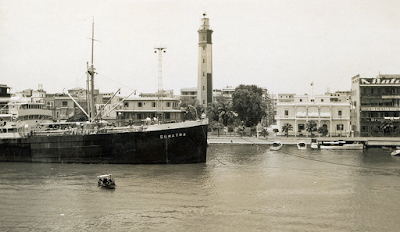
91. The Port Said lighthouse at a height of 60 feet should not be visible from a ship 58 miles away on a spherical Earth

Image
“The lighthouse at Port Said, Egypt, at an elevation of only 60 feet has been seen an astonishing 58 miles away, where, according to modern astronomy it should be 2,182 feet below the line of sight!” Dubay and Winship can't do trigonometry for this unverifiable historic observation As usual his calculations are incorrect. Using the correct figure and calculation, the observer on the ship would have to be at a height of 1569 feet. Dubay copied this account from Thomas Winship's Zetetic Cosmogeny. "Extract from a letter written by a passenger on hoard the SS Iberia, Orient Line.  "At noon on Thursday, 27th of  September, we were 169 miles from Port Said ; by the ship's log, our rate of steaming was 324 miles in 24 hours. At 12 p.m., we were alongside the lighthouse at Port Said, it having become visible at 7.30 when it was about 58 miles away. It is an ordinary tower, about as high as the tower at Springhead (60 feet), lit by electricity." Accord...

90. The Statue of Liberty at a height of 326 feet should not be visible from a ship 60 miles away on a spherical Earth

Image
“The Statue of Liberty in New York stands 326 feet  above sea level and on a clear day can be seen as far as 60  miles away. If the Earth were a globe, that would put Lady  Liberty at an impossible 2,074 feet below the horizon.” Dubay can't do trigonometry and provides no evidence As usual his calculations are incorrect. Using the correct figure and calculation, the observer on the ship would have to be at a height of 957 feet. However Dubay does not state where his claim comes from and I have not been able to find any testimonials that state that the Statue of Liberty was sighted from 60 miles away. I suggest that Dubay conduct an experiment and provide us with some evidence in order to construct a credible proof. < Prev     81-90    Next >

89. The Cape L’Agulhas lighthouse at a height of 238 feet should not be visible from a ship 50 miles away on a spherical Earth

Image
“The Cape L’Agulhas lighthouse in South Africa is 33  feet high, 238 feet above sea level, and can be seen for over  50 miles. If the world were a globe, this light would fall  1,400 feet below an observer’s line of sight.” This is an unverifiable 1898 testimony. As usual Dubay and Winship get their calculation wrong, but even with the correct calculation the light would be 645 feet below the horizon. According to Thomas Winship (Zetetic Consmogeny) this "proof" is taken from an article The Natal Mercury of 18th July, 1898. However, this being yet another historic quote from the 1800's there is no way to verify whether this account was accurate so really cannot be considered as proof of anything. Since it is no longer in operation it would take quite a lot of effort to actually perform some verifiable measurements, but that is exactly what would be required to construct a credible proof. There is also good reason to believe that these observations of distant...

88. The Isle of Wight lighthouse at a height of 180 feet should not be visible from a ship 42 miles away on a spherical Earth

Image
“The Isle of Wight lighthouse in England is 180 feet high  and can be seen up to 42 miles away, a distance at which  modern astronomers say the light should fall 996 feet below  line of sight.” This is late 1800's testimony from a flat earth believer and activist According to Thomas Winship (Zetetic Consmogeny) this proof is taken from an article in "The Earth - not a globe - Review", a flat earth publication, titled "The Bible verses Science" by J. C. Akester.  I believe that J. C. Akester was the long-time flat earther activist in the Universal Zetetic Society founded in 1892. So not exactly a disinterested source of information and as an unverifiable claim can hardly be considered a proof. There is also good reason to believe that these observations of distant lighthouse sightings are bogus. For details click the link below. Why Dubay's lighthouse quotes are bogus < Prev     81-90    Next >

87. The lighthouse steeple of St Botolph's Parish Church at a height of 290 feet should not be visible from a ship 40 miles away on a spherical Earth

Image
“The lighthouse steeple of St Botolph's Parish Church in Boston is 290 feet tall and visible from over 40 miles away, where it should be hidden a full 800 feet below the horizon.” Probably a bogus observation, but in any case Dubay and Samuel Rowbotham can't do trigonometry. For evidence that the quoted observation is bogus, click here: Why Dubay's lighthouse quotes are bogus However, if you want to take the observation as genuine read on to see why this still does not add up to a proof. Using the correct figure and calculation, the observer on the ship would have to be at a height of 244 feet.  From the deck of a ship that would mean that the observer would be about 238 feet too low to see the lighthouse. According to Thomas Winship ( Zetetic Consmogeny ) this proof is taken from an 2nd May 1896 publication called "Answers".  In 1886 the ships that would be observing the lighthouse would be sailing ships or steam ships that still had sails...

86. The Cape Bonavista Light at a height of 150 feet should not be visible from a ship 35 miles away on a spherical Earth

Image
“The light at Cape Bonavista, Newfoundland is 150 feet above sea-level and visible at 35 miles, where it should be 491 feet below the horizon.” Probably a bogus observation, but in any case Dubay and Samuel Rowbotham can't do trigonometry. For evidence that the quoted observation is bogus, click here: Why Dubay's lighthouse quotes are bogus However, if you want to take the observation as genuine read on to see why this still does not add up to a proof. The focal height of the light is actually 167 feet not 150. Using the correct figure and calculation, the observer on the ship would have to be at a height of 245 feet.  From the deck of a ship that would mean that the observer would be about 239 feet too low to see the lighthouse. However, as  with so many of Dubays "proofs" this is taken from Samuel Rowbotham's "Zetetic Astronomy: Earth Not a Globe" published in 1881. The relevant paragraphs from the book are: "Many instances ...

85. The Cordouan Light at a height of 207 feet should not be visible from a ship 31 miles away on a spherical Earth

Image
“The Cordonan Light on the west coast of France is 207 feet high and visible from 31 miles away, where it should be 280 feet below the line of sight.” Probably a bogus observation, but in any case Dubay and Samuel Rowbotham can't do trigonometry. For evidence that the quoted observation is bogus, click here: Why Dubay's lighthouse quotes are bogus However, if you want to take the observation as genuine read on to see why this still does not add up to a proof. Using the correct calculation, the observer on the ship would have to be at a height of 119 feet. From the deck of a ship that would mean that the observer would be about 103 feet too low to see the lighthouse. However, as  with so many of Dubays "proofs" this is taken from Samuel Rowbotham's "Zetetic Astronomy: Earth Not a Globe" published in 1881. The relevant paragraphs from the book are: "Many instances could be given of lights being visible at sea for distances whic...

84. The Madras Light at a height of 132 feet should not be visible from a ship 28 miles away on a spherical Earth

Image
“The Light at Madras on the Esplanade, is 132 feet high and visible from 28 miles away, where it should be 250 feet below the line of sight.” Probably a bogus observation, but in any case Dubay and Samuel Rowbotham can't do trigonometry. For evidence that the quoted observation is bogus, click here: Why Dubay's lighthouse quotes are bogus However, if you want to take the observation as genuine read on to see why this still does not add up to a proof. Using the correct calculation, the observer on the ship would have to be at a height of 129 feet. From the deck of a ship that would mean that the observer would be about 114 feet too low to see the lighthouse. However, as  with so many of Dubays "proofs" this is taken from Samuel Rowbotham's "Zetetic Astronomy: Earth Not a Globe" published in 1881. The relevant paragraphs from the book are: "Many instances could be given of lights being visible at sea for distances which would b...

83. The Eigerøy Light at a height of 154 feet should not be visible from a ship 28 miles away on a spherical Earth

Image
“The Egerö Light in Norway is 154 feet above high water and visible from 28 miles statute miles where it should be 230 feet below the horizon.” Probably a bogus observation, but in any case Dubay and Samuel Rowbotham can't do trigonometry. For evidence that the quoted observation is bogus, click here: Why Dubay's lighthouse quotes are bogus However, if you want to take the observation as genuine read on to see why this still does not add up to a proof. Using the correct calculation, the observer on the ship would have to be at a height of 109 feet. From the deck of a ship that would mean that the observer would be about 90 feet too low to see the lighthouse. However, as  with so many of Dubays "proofs" this is taken from Samuel Rowbotham's "Zetetic Astronomy: Earth Not a Globe" published in 1881. The relevant paragraphs from the book are: "Many instances could be given of lights being visible at sea for distances which would b...

82. The Port Nicholson Light at a height of 420 feet should not be visible from a ship 35 miles away on a spherical Earth

Image
“The Port Nicholson Light in New Zealand is 420 feet above sea-level and visible from 35 miles away where it should be 220 feet below the horizon.” Probably a bogus observation, but in any case Dubay and Samuel Rowbotham can't do trigonometry. For evidence that the quoted observation is bogus, click here: Why Dubay's lighthouse quotes are bogus However, if you want to take the observation as genuine read on to see why this still does not add up to a proof. Dubay again uses the incorrect calculation to determine how high the observer needs to be to see the light. Using the correct calculation, the observer on the ship would have to be at a height of 65 feet. From the deck of a ship that would mean that the observer would be about 50 feet too low to see the lighthouse. However, as  with so many of Dubays "proofs" this is taken from Samuel Rowbotham's "Zetetic Astronomy: Earth Not a Globe" published in 1881. The relevant paragraphs f...

81. The Dunkirk Light at a height of 194 feet should not be visible from a ship 28 miles away on a spherical Earth

Image
“The distance from which various lighthouse lights around the world are visible at sea far exceeds what could be found on a ball-Earth 25,000 miles in circumference. For example, the Dunkerque Light in southern France at an altitude of 194 feet is visible from a boat (10 feet above sea-level) 28 miles away. Spherical trigonometry dictates that if the Earth was a globe with the given curvature of 8 inches per mile squared, this light should be hidden 190 feet below the horizon.” Probably a bogus observation, but in any case Dubay and Samuel Rowbotham can't do trigonometry. For evidence that the quoted observation is bogus, click here: Why Dubay's lighthouse quotes are bogus However, if you want to take the observation as genuine read on to see why this still does not add up to a proof. . Firstly Dubay again uses the incorrect calculation to determine how high the observer needs to be to see the light.  Using the correct calculation, the observer on the ship ...

80. Dubay takes an article about Mirages and tries to use it as proof of a flat Earth

Image
“In Chambers’ Journal, February 1895, a sailor near Mauritius in the Indian Ocean reported having seen a vessel which turned out to be an incredible 200 miles away! The incident caused much heated debate in nautical circles at the time, gaining further confirmation in Aden, Yemen where another witness reported seeing a missing Bombay steamer from 200 miles away. He correctly stated the precise appearance, location and direction of the steamer all later corroborated and confirmed correct by those onboard. Such sightings are absolutely inexplicable if the Earth were actually a ball 25,000 miles around, as ships 200 miles distant would have to fall approximately 5 miles below line of sight!” It is ironic that the article that Dubay quotes from is actually about Mirages, explaining how objects can be seen far beyond the horizon. From the following link you can download the journal in various formats. https://archive.org/details/in.ernet.dli.2015.350426 Below are most of the re...

79. From Anchorage at a height of 102 feet Mount McKinley should not be visible on a spherical Earth

Image
“From Anchorage, Alaska at an elevation of 102 feet, on clear days Mount McKinley can be seen with the naked eye from 130 miles away. If Earth were a ball 25,000 miles in circumference, Mount McKinley’s 20,320 foot summit should be leaning back away from the observer and almost half covered by 9,220 feet of curved Earth. In reality, however, the entire mountain can be quite easily seen standing straight from base to summit.” Dubay gets his calculations wrong again. Dubay's miscalculation occurs because he does not understand that the height of the observer makes a huge difference to the visibility of objects beyond the horizon. Using the correct calculation, with an observer at 102 feet, and at a distance if 133 miles, the obscured height of Mt McKinley is 9808 feet.  This will leave 10,612 feet of the mountain visible. Looking at the following profile of Mt McKinley (on the right) you can clearly see that the visible part of the mountain in Dubay's image is on...