Posts

Showing posts with the label False facts

88. The Isle of Wight lighthouse at a height of 180 feet should not be visible from a ship 42 miles away on a spherical Earth

Image
“The Isle of Wight lighthouse in England is 180 feet high  and can be seen up to 42 miles away, a distance at which  modern astronomers say the light should fall 996 feet below  line of sight.” This is late 1800's testimony from a flat earth believer and activist According to Thomas Winship (Zetetic Consmogeny) this proof is taken from an article in "The Earth - not a globe - Review", a flat earth publication, titled "The Bible verses Science" by J. C. Akester.  I believe that J. C. Akester was the long-time flat earther activist in the Universal Zetetic Society founded in 1892. So not exactly a disinterested source of information and as an unverifiable claim can hardly be considered a proof. There is also good reason to believe that these observations of distant lighthouse sightings are bogus. For details click the link below. Why Dubay's lighthouse quotes are bogus < Prev     81-90    Next >

87. The lighthouse steeple of St Botolph's Parish Church at a height of 290 feet should not be visible from a ship 40 miles away on a spherical Earth

Image
“The lighthouse steeple of St Botolph's Parish Church in Boston is 290 feet tall and visible from over 40 miles away, where it should be hidden a full 800 feet below the horizon.” Probably a bogus observation, but in any case Dubay and Samuel Rowbotham can't do trigonometry. For evidence that the quoted observation is bogus, click here: Why Dubay's lighthouse quotes are bogus However, if you want to take the observation as genuine read on to see why this still does not add up to a proof. Using the correct figure and calculation, the observer on the ship would have to be at a height of 244 feet.  From the deck of a ship that would mean that the observer would be about 238 feet too low to see the lighthouse. According to Thomas Winship ( Zetetic Consmogeny ) this proof is taken from an 2nd May 1896 publication called "Answers".  In 1886 the ships that would be observing the lighthouse would be sailing ships or steam ships that still had sails...

86. The Cape Bonavista Light at a height of 150 feet should not be visible from a ship 35 miles away on a spherical Earth

Image
“The light at Cape Bonavista, Newfoundland is 150 feet above sea-level and visible at 35 miles, where it should be 491 feet below the horizon.” Probably a bogus observation, but in any case Dubay and Samuel Rowbotham can't do trigonometry. For evidence that the quoted observation is bogus, click here: Why Dubay's lighthouse quotes are bogus However, if you want to take the observation as genuine read on to see why this still does not add up to a proof. The focal height of the light is actually 167 feet not 150. Using the correct figure and calculation, the observer on the ship would have to be at a height of 245 feet.  From the deck of a ship that would mean that the observer would be about 239 feet too low to see the lighthouse. However, as  with so many of Dubays "proofs" this is taken from Samuel Rowbotham's "Zetetic Astronomy: Earth Not a Globe" published in 1881. The relevant paragraphs from the book are: "Many instances ...

85. The Cordouan Light at a height of 207 feet should not be visible from a ship 31 miles away on a spherical Earth

Image
“The Cordonan Light on the west coast of France is 207 feet high and visible from 31 miles away, where it should be 280 feet below the line of sight.” Probably a bogus observation, but in any case Dubay and Samuel Rowbotham can't do trigonometry. For evidence that the quoted observation is bogus, click here: Why Dubay's lighthouse quotes are bogus However, if you want to take the observation as genuine read on to see why this still does not add up to a proof. Using the correct calculation, the observer on the ship would have to be at a height of 119 feet. From the deck of a ship that would mean that the observer would be about 103 feet too low to see the lighthouse. However, as  with so many of Dubays "proofs" this is taken from Samuel Rowbotham's "Zetetic Astronomy: Earth Not a Globe" published in 1881. The relevant paragraphs from the book are: "Many instances could be given of lights being visible at sea for distances whic...

84. The Madras Light at a height of 132 feet should not be visible from a ship 28 miles away on a spherical Earth

Image
“The Light at Madras on the Esplanade, is 132 feet high and visible from 28 miles away, where it should be 250 feet below the line of sight.” Probably a bogus observation, but in any case Dubay and Samuel Rowbotham can't do trigonometry. For evidence that the quoted observation is bogus, click here: Why Dubay's lighthouse quotes are bogus However, if you want to take the observation as genuine read on to see why this still does not add up to a proof. Using the correct calculation, the observer on the ship would have to be at a height of 129 feet. From the deck of a ship that would mean that the observer would be about 114 feet too low to see the lighthouse. However, as  with so many of Dubays "proofs" this is taken from Samuel Rowbotham's "Zetetic Astronomy: Earth Not a Globe" published in 1881. The relevant paragraphs from the book are: "Many instances could be given of lights being visible at sea for distances which would b...

83. The Eigerøy Light at a height of 154 feet should not be visible from a ship 28 miles away on a spherical Earth

Image
“The Egerö Light in Norway is 154 feet above high water and visible from 28 miles statute miles where it should be 230 feet below the horizon.” Probably a bogus observation, but in any case Dubay and Samuel Rowbotham can't do trigonometry. For evidence that the quoted observation is bogus, click here: Why Dubay's lighthouse quotes are bogus However, if you want to take the observation as genuine read on to see why this still does not add up to a proof. Using the correct calculation, the observer on the ship would have to be at a height of 109 feet. From the deck of a ship that would mean that the observer would be about 90 feet too low to see the lighthouse. However, as  with so many of Dubays "proofs" this is taken from Samuel Rowbotham's "Zetetic Astronomy: Earth Not a Globe" published in 1881. The relevant paragraphs from the book are: "Many instances could be given of lights being visible at sea for distances which would b...

82. The Port Nicholson Light at a height of 420 feet should not be visible from a ship 35 miles away on a spherical Earth

Image
“The Port Nicholson Light in New Zealand is 420 feet above sea-level and visible from 35 miles away where it should be 220 feet below the horizon.” Probably a bogus observation, but in any case Dubay and Samuel Rowbotham can't do trigonometry. For evidence that the quoted observation is bogus, click here: Why Dubay's lighthouse quotes are bogus However, if you want to take the observation as genuine read on to see why this still does not add up to a proof. Dubay again uses the incorrect calculation to determine how high the observer needs to be to see the light. Using the correct calculation, the observer on the ship would have to be at a height of 65 feet. From the deck of a ship that would mean that the observer would be about 50 feet too low to see the lighthouse. However, as  with so many of Dubays "proofs" this is taken from Samuel Rowbotham's "Zetetic Astronomy: Earth Not a Globe" published in 1881. The relevant paragraphs f...

81. The Dunkirk Light at a height of 194 feet should not be visible from a ship 28 miles away on a spherical Earth

Image
“The distance from which various lighthouse lights around the world are visible at sea far exceeds what could be found on a ball-Earth 25,000 miles in circumference. For example, the Dunkerque Light in southern France at an altitude of 194 feet is visible from a boat (10 feet above sea-level) 28 miles away. Spherical trigonometry dictates that if the Earth was a globe with the given curvature of 8 inches per mile squared, this light should be hidden 190 feet below the horizon.” Probably a bogus observation, but in any case Dubay and Samuel Rowbotham can't do trigonometry. For evidence that the quoted observation is bogus, click here: Why Dubay's lighthouse quotes are bogus However, if you want to take the observation as genuine read on to see why this still does not add up to a proof. . Firstly Dubay again uses the incorrect calculation to determine how high the observer needs to be to see the light.  Using the correct calculation, the observer on the ship ...

72. Dubay lies about the distance from Grimsby to Hull to make his proof

Image
“October 16, 1854 the Times newspaper reported the Queen’s visit to Great Grimsby from Hull recording they were able to see the 300 foot tall dock tower from 70 miles away. On a ball-Earth 25,000 miles in circumference, factoring their 10 foot elevation above the water and the tower’s 300 foot height, at 70 miles away the dock tower should have remained an entire 2,600 feet below the horizon.” Dubay is making up mileages again.  It looks likely that he is a compulsive liar. Grimsby Dock Tower is only 16 miles from Hull.  Dubay is just making up the 70 mile figure. From the tower, Hull 16 miles away is not obscured at all by the curvature of the Earth. < Prev  71-80 Next >

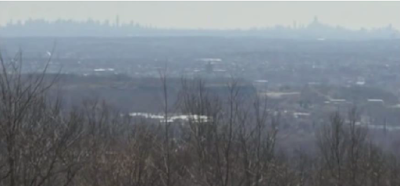
70. The skylines of New York and Philadelphia should not be visible from Washington's Rock on a spherical Earth

Image
“From Washington’s Rock in New Jersey, at just a 400 foot elevation, it is possible on a clear day to see the skylines of both New York and Philadelphia in opposite directions at the same time covering a total distance of 120 miles! If Earth were a ball 25,000 miles in circumference, both of these skylines should be hidden behind over 800 feet of Earth’s curvature.” Dubay gets his distances wrong so often I suspect that he is deliberately lying to help make his proof.  In this "proof"  he lies about distances and elevation and can’t do the maths. Washington Rock State Park is 47 miles from Philadelphia and 27 miles from New York.  47+27 = 74 so Dubay's claimed 120 miles is a blatant lie even by his standards.  The highest elevation in Washington Rock is over 500 feet not 400 feet. If we ignore refraction, from Washington Rock State Park objects 256 feet above sea level are visible in Philadelphia and objects in New York are not obscured at all. Conseque...

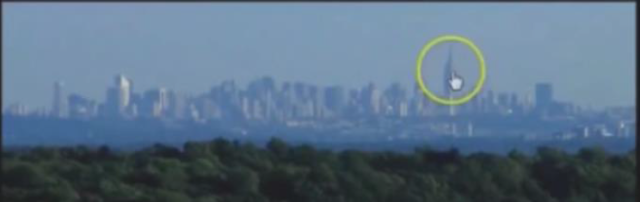
69. From Bear Mountain the New York City skyline should not be visible on a spherical Earth

Image
“The New York City skyline is clearly visible from Harriman State Park’s Bear Mountain 60 miles away. If Earth were a ball 25,000 miles in circumference, viewing from Bear Mountain’s 1,283 foot summit, the Pythagorean Theorem determining distance to the horizon being 1.23 times the square root of the height in feet, the NYC skyline should be invisible behind 170 feet of curved Earth.” Dubay can’t do trigonometry, maths or look up distances From the peak of Bear Mountain (1,280 feet) the horizon almost 44 miles away.  New York is only 40 miles from Bear Mountain as the crow flies so nothing obscured by the curvature of the earth.  I am pretty sure that Dubay does not understand how much the elevation of the observer affects the distance to the horizon and does not use it in his calculations. Just one more example of Dubay getting his facts wrong and screwing up the maths. < Prev  61-70 Next >

68. The Philadelphia skyline should not be visible from Apple Pie Hill on a spherical Earth

Image
“The Philadelphia skyline is clearly visible from Apple Pie Hill in the New Jersey Pine Barrens 40 miles away. If Earth were a ball 25,000 miles in circumference, factoring in the 205 foot elevation of Apple Pie Hill, the Philly skyline should remain well-hidden beyond 335 feet of curvature .” Dubay can’t do trigonometry or maths or look up distances Always best to fact check Eric Dubay.  The distance from Apple Pie Hill to the sky scrapers in Philadelphia is 40 miles …. by road!   As the crow flies it is only 32 miles.  If the observation point is 205 feet, and we ignore refraction,  139 feet of the Philadelphia skyline will be obscured by the curvature of the earth.  Since the part of Philadelphia being observed is itself at an elevation of 32 feet, only 107 feet of the buildings are obscured. I checked the height of the 30 tallest buildings and all of them have between 73% and 89% of their height visible. So all is as it should be on a sphe...

40. The distance between Cape Horn and Melbourne proves that the Earth is not the size scientists say

Image
“From near Cape Horn, Chile to Port Philip in Melbourne, Australia the distance is 10,500 miles, or 143 degrees of longitude away. Factoring in the remaining degrees to 360 makes for a total distance of 26,430 miles around this particular latitude, which is over 1500 miles wider than Earth is supposed to be at the equator, and many more thousands of miles wider than it is supposed to be at such Southern latitudes.” Same as proof 39 .  Dubay again quotes incorrect distances and uses incorrect trigonometry. Distance from Cape Horn to Melbourne is 5689 miles not 10,500 miles as stated.  I have no idea where he got his figure from. Cape Horn, Chile co-ordinates are Latitude -55.98° (-55° 59' 0"), longitude -67.27° (67° 16' 0") Port Philip, Melbourne co-ordinates are Latitude -37.846498° (-37° 50' 47"), longitude 144.97° (144° 58' 0") Using the correct formula to work out the angle between these two locations (See: proof 39 ), the correct a...

39. An Almanac published in the 1870's stated a distance between Sydney and Nelson that disagrees with current maps

Image
“Practical distance measurements taken from “The Australian Handbook, Almanac, Shippers’ and Importers’ Directory” state that the straight line distance between Sydney and Nelson is 1550 statute miles. Their given difference in longitude is 22 degrees 2’14”. Therefore if 22 degrees 2’14” out of 360 is 1550 miles, the entirety would measure 25,182 miles. This is not only larger than the ball-Earth is said to be at the equator, but a whole 4262 miles greater than it would be at Sydney’s southern latitude on a globe of said proportions.” Incorrect historical information and Dubay does not know how to do trigonometry. Once again Eric Dubay resorts to historical sources, in this case The Australian Handbook, Almanac, Shippers’ and Importers’ Directory” which was published between 1872-1879. The distance it is reported as quoting between Sydney and Nelson is 1550 miles which is incorrect. The Almanac might not have been quoting the mileage as the crow flies, or maybe they just got the ...